






If you're planning a custom home, someone has probably already told you spray foam is the best insulation money can buy, and you’ve probably scrolled social media to find videos saying it’s toxic. So is spray foam insulation safe? It's one of the questions I get asked most, usually by families who already have an architect and a plan in progress. Some families have someone in the family who's sensitive to mold or chemical sensitivities (MCS or MCAS), where an insulation choice is far more than just personal preference.
Almost every answer you’ll find online comes from a company that sells spray foam, and they all land in the same place, it's safe when it's installed correctly. That isn't wrong. What none of them tell you is that there is no such thing as perfection when it comes to construction. We have humans applying spray foam, and human error is an inherent part of the process. So how can you gain the peace of mind to know if the spray foam is installed correctly if you do select it for your home?
Short answer: spray foam can be a reasonable choice in specific places, but its key ingredient, isocyanates, can cause asthma and other health problems during installation and has the potential to off-gas a while afterward, and no one can tell you yet exactly what it gives off over the long term. Whether it's safe in your home depends on the product, the assembly around it, and how the install and cure are controlled.
Here's how I explain it to families. Spray foam does a few jobs really well, the closed-cell variety is a good vapor barrier, air seals well, and has a higher R-value compared to other insulation types. But the chemistry that makes it work is also what makes it risky. Its main ingredient, isocyanates, can cause asthma and lung damage, along with skin and eye irritation, during installation and for a period after installation. That's why the crew is in full protective gear, and your family is told to stay away during application.
Once it's applied correctly and fully cured, it's considered relatively inert. I want you to notice those two words, "correctly" and "fully cured," because on most projects nobody is assigned to prove either one was successful.
What most people don't realize is that spray foam isn't a finished product. Batts show up on a truck already made. Spray foam is two liquids that react on site, and it can look hard within seconds while it's still curing. The final product is literally manufactured inside your house, by a crew, in whatever weather that day brings.
So the weather on application day matters a lot. Temperature, humidity, whether the HVAC was shut off, whether the mix and thickness were right, all of these affect how it cures. Foam that doesn't cure properly can keep off-gassing and contaminate other surfaces in the house. In fact, Federal court filings in a half dozen states allege that spray polyurethane foam is defective and dangerous to homeowners.
And even when everything goes right, the science isn't settled. Long-term off-gassing from spray foam still isn't fully understood. One federal study in a test home found occupants could be exposed to measurable flame retardant levels two years after open-cell foam was applied.
So my honest answer to "is spray foam insulation safe" is this: it can be, in the right location, with the right product, installed under the right conditions, and independently inspected. That's four areas that nearly need to be perfect.
I’ve been brought into projects mid-construction when spray foam was already installed and we quickly coordinated check and balances. I’ve been brought into projects when the homeowner was told spray foam insulation was their only solution and helped weigh all the insulation possibilities so the homeowner sisn’t feel backed into a corner. The best opportunity for peace of mind is whe we are brought into a project in the early design stages, where we can collaborate and strategize with the architect and contractor so the right insulation strategy isn’t an afterthought, but detailed into the plans.
No, spray foam is not required by code. Energy codes set an efficiency target and give you more than one path to hit it. Spray foam is one way to comply, but code doesn’t mandate an insulation specification. If someone on your project tells you that you have to use spray foam to pass code, ask:
“Which compliance path are you using and what are the alternatives?”
That one question tends to open up the conversation.
California is a good example, since it wrote the nation's first building energy standards back in the 1970s. A new home can get its permit two ways. The prescriptive path means meeting a listed requirement for each part of the building. The performance path uses energy modeling software and lets you trade off features as long as the whole house hits the same target, and it's the path most builders take.
When California raised its attic requirements in the 2016 code, the prescriptive choices were:
The code has been updated since then, so ask your energy consultant (in California, the person who runs your Title 24 compliance model) to walk you through the current options for your climate zone. Outside California, ask whoever is running your energy compliance.
Spray foam is very good at air sealing, because the mixture expands to fill gaps that conventional batt insulation can’t reach. What it can't do on its own is manage moisture if there is a defect, bring in fresh air, or plan for what happens to your house over the next fifty years. Those depend on the whole assembly, meaning every layer of the wall or roof working together. This is what I mean when I say healthy is an assembly, not a shopping list.
There are two types of spray foam, and they each behave differently.
Those differences change how a wall or roof dries. That’s why I like to see the insulation choice made in the assembly design during planning, not left to the insulation bid.
Moisture is the single greatest threat to how long a house lasts, and spray foam changes where moisture can move. When California builders first moved insulation up to the roof deck, their biggest worry was moisture trapped against the deck, condensing and causing the sheathing to fail early. As of that report, some major production builders still banned those attics. Spray foam doesn’t create moisture, but it decides where moisture can and can’t escape.
This is where I see one of the biggest disconnects. Insulation is supposed to seal your house and provide R-value, and a sealed house holds onto emissions from the foam and from everything else inside it with typical living conditions. Ventilation has to be designed alongside the insulation, during planning, to ensure sufficient fresh air and humidity control is planned for.
This is the part families seldom hear. Years from now, a plumber or electrician who heats or grinds the foam can release toxic emissions, and so can a remodel or demolition in the future. In a fire, burning spray foam can release isocyanates and hydrogen cyanide. Your house will outlive this build, so plan for the people who work on it later and what that can mean if you opt for spray foam in your walls. Spray foam doesn’t just get pulled out like conventional batts; it often needs to be cut out or remediated if removal is needed in the future.
With the right strategy, there are other insulation types and strategies that can perform just as well as spray foam, and in some assemblies even better. The ones I talk through most with families are rigid board, sheep's wool, mineral wool, wood fiber, and formaldehyde-free fiberglass.
This is important. No single insulation choice is a like-for-like swap for spray foam on its own. Spray foam air seals and insulates in one step, and most of these only insulate, so something else in the assembly has to handle the air sealing. The right choice depends on your home, your climate, and where in the wall or roof the insulation is going.
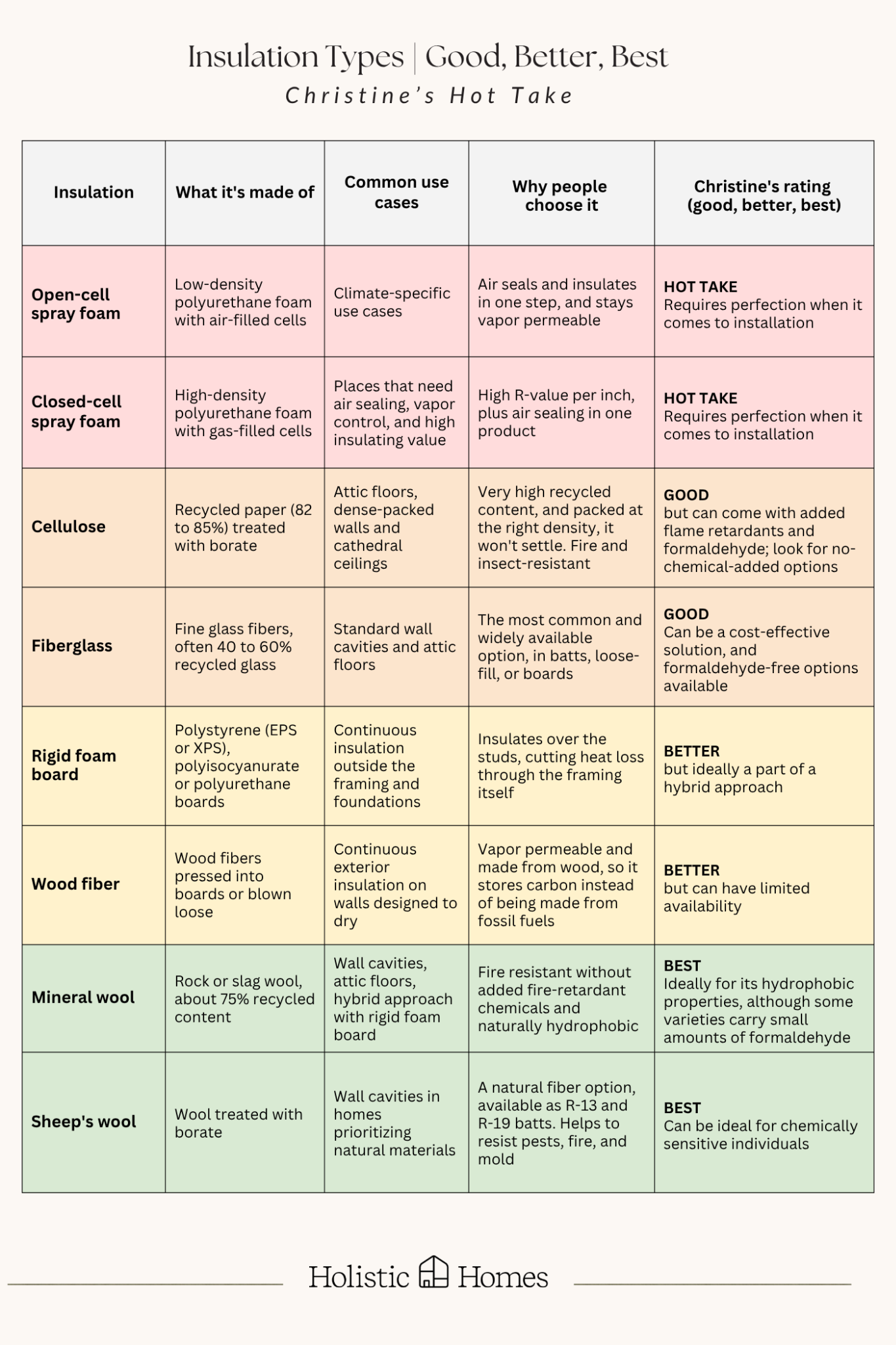
Pro tip: drywall only works as an air barrier when it's sealed at its edges and every penetration, like outlets and recessed lights, and in my experience, most drywall installs aren't done that way. That means whatever insulation sits behind your drywall can affect the air you breathe.
By volume alone, this choice matters. Insulation goes into every exterior wall cavity, and sometimes interior walls too, so it touches a lot of your house.
So, the question isn't foam or no foam. It's, “What does the job, considers my healthy home expectations, and meets my budget goals?”
Something has to control the air, something has to insulate, and something has to manage moisture.
Every layer has a job.
Whether you're weighing spray foam vs mineral wool or any other pair, I'd compare them by where they go and what to ask, not by which one wins a "healthiest" contest.
Why Insulation Deserves More Attention Than Your Finishes
Once the drywall goes up, your insulation is in there for the life of the house. Changing a paint color needs a paintbrush. Changing insulation requires a sledgehammer, and with spray foam, even the sledgehammer may not work. There's no standard accepted way to remove it, and taking it out can create new problems without solving the original one.
My guess is most families spend more meetings on tile than on what's inside their walls, and that's understandable, tile is what you see. But tile can be replaced on a weekend. Whether spray foam insulation is safe in your specific assembly is a question that gets answered once, before the walls close.
This is the kind of decision I help families think through as a healthy home owner's rep, long before an insulation crew is ever scheduled. Here’s a short list to consider as you navigate this topic.
Make your insulation decisions during design, not on installation day. By the time a crew shows up, the important choices should already be made. Here's what that looks like.
It can. Foam that's applied correctly and fully cured is considered relatively inert, but temperature, humidity, jobsite practices and the installer's technique all affect how it cures, and poorly cured foam can off-gas over time. Long-term spray foam off-gassing still isn't fully understood, which is why I care so much about install conditions and documentation.
It depends on the product, so get the manufacturer's re-occupancy time in writing before the job starts. Some manufacturers recommend 24 hours for professional two-component foam, but it varies, and curing rates are still being studied. In new construction, the same rule applies to every other trade on site.
Spray foam doesn't cause mold by itself, since mold needs moisture. The risk comes from the assembly around it. When builders move insulation up to the roof deck, the worry is moisture trapped against the deck with have no way to dry. A hygrothermal analysis during design is one tool we use during the early collaborative stages to discuss if the insulation strategy is on the right path.
Neither type is safe or unsafe on its own, and both come from the same on-site chemical reaction. They differ in density and vapor permeability, which changes where each one belongs in an assembly. The better question is which one your assembly calls for, and how its installation and cure will be controlled.
So, is spray foam insulation safe? It can be a reasonable choice in the right place, but only when the product, the assembly, the install conditions and the cure are all decided ahead of time and checked, and that work belongs in design, not on spray day. Healthy is an assembly, not a shopping list, and the decisions that shape it happen before you break ground.
If you're planning a custom home or a gut renovation and want to feel supported and confident about what goes inside your walls, from the very first floor plan your architect shows you, tell us more about your project here.
Your family deserves a safe, healthy home. Let’s start planning together.
Tell Us About Your Project