





A great contractor for a conventional home is not automatically a great contractor for a healthy home. The skill sets overlap, but they aren't the same.
That's why the questions to ask a contractor are different when you're building for health.
Short answer: the questions to ask a contractor for a healthy home go beyond contracts and timelines. Ask how they handle air quality during construction, humidity and rain on the jobsite, material substitutions, and third-party inspections. The best answers are honest and curious, not perfect.
For homeowners who are mold-affected, chemically sensitive, or building specifically to protect the long-term health of their family, the wrong hire isn't a budget setback. It's a health setback. I've seen well-intentioned contractors with strong reputations completely miss the mark on these projects, not because they're bad at building, but because no one ever asked them the right questions before signing the contract.
This isn't a general contractor vetting checklist. There are plenty of those online, and your accountant, your lawyer, and your realtor will all have opinions on contracts and timelines. What's missing, and what makes or breaks a healthy home, are the questions specific to building for health. That's what this post covers.
Conventional contractors are trained to build to code. Code is a minimum, not a health standard; the residential code itself describes its purpose as minimum requirements for safety, health and general welfare. Most building codes are silent on indoor air quality during construction, fungicide content in materials, jobsite humidity management, and the dozens of small decisions made daily that determine how your finished home performs.
A healthy home contractor brings a different toolkit. They've thought about what happens if framing gets rained on, what goes into the wall cavity that you'll never see again, and how to manage humidity on the job site so the materials you've carefully selected don't grow mold before drywall ever goes up. They're comfortable being looped into design conversations early. They welcome third-party oversight, because they know another set of trained eyes only makes the project better.
Finding a contractor who already speaks this language is the first hard problem. The interview is the second. The Holistic Homes Directory was built to solve the first — a national network of pre-vetted healthy building professionals so you don't have to start cold.
This is a roadmap to an open-ended conversation, not a test where the contractor passes or fails. Plan to interview at least three to five contractors. The first one is rarely the right one.
What I'm listening for when I interview my own subcontractors isn't a perfect answer. It's an honest answer, a curious answer, and a willingness to learn what they don't already know. That third quality is the rarest and the most valuable.
The ⚠️ icons throughout flag responses worth a follow-up question: not deal-breakers, just answers that warrant another question before moving on.
This section reveals whether the contractor has actually worked on healthy home projects and how they think about the work, not just whether they're willing to take the job.
What to listen for: The honest answer "I haven't done that before, but here's how I'd approach it with your guidance" is often better than "yes, I do all that." The first contractor is being truthful and showing you they're coachable. The second may be telling you what they think you want to hear. ⚠️ A contractor who waves off the consultant question, or who tells you they don't need outside guidance, is telling you something important about how the project will go when there's a difference of opinion.
Talk to past clients. Touring an active job site tells you what a contractor looks like when they're performing for you. Talking to a homeowner who's lived in a finished house for two years tells you what they're actually like.
This is one of the most consequential parts of the build and one of the most overlooked. Construction generates enormous amounts of particulate: drywall dust, sawdust, off-gassing from materials, demolition debris. How that's managed determines what gets baked into your finished home.
What to listen for: Running a brand-new HVAC system during construction is one of the most common ways healthy homes end up contaminated before the homeowner ever moves in. Dust, drywall particulate, and off-gassing get pulled directly through the system and lodge in the ductwork and equipment. ⚠️ A contractor who shrugs at the HVAC question, or who tells you it's fine to run the new system to "keep the jobsite comfortable," is telling you they don't yet understand the stakes. The same goes for air scrubbers and negative air machines. If they've never used them, the follow-up is how they plan to manage indoor air quality on your specific project.
This section reveals how the contractor protects your home from the conditions that create mold problems in the first place, both during construction and built into the finished assembly. It matters because HUD's building research describes moisture as commonly regarded as the single greatest threat to the durability of housing.
What to listen for: Materials that absorb moisture on the jobsite, (framing lumber, drywall, insulation) can grow mold before they're ever enclosed in your walls.
⚠️ If a contractor doesn't routinely monitor humidity during construction or doesn't have dehumidifiers as part of their standard kit, that's a real follow-up conversation. On waterproofing, there's a meaningful difference between a contractor who relies on the standard cement board and thinset approach versus one who uses a fully bonded waterproof membrane system and performs a flood test before tile goes down. Both can produce a watertight shower; one produces a far more forgiving assembly if anything ever goes wrong. The dried-in question is the one most homeowners never ask. The longer your framing sits exposed to weather, the higher the risk of moisture issues baked permanently into your walls.
On a conventional project, swapping one brand of caulk or one drywall product for another is no big deal. On a healthy home project, it can undo months of careful material vetting.
What to listen for: ⚠️ If a contractor tells you they typically handle substitutions in-house without client approval, that's worth a serious follow-up. You need explicit written confirmation that no material substitutions will occur without your sign-off, period. Subcontractors are where carefully built protocols quietly fall apart. The GC may understand your project entirely, but the framer, the painter, the tile setter, and the HVAC installer each need to understand it too.
This section assesses how willing the contractor is to work alongside third-party experts and how transparent they are about the work that's hidden behind your walls forever.
What to listen for: The healthy home process leans heavily on building science consultants, indoor air quality testing, and pre-drywall inspections {→ pre-drywall inspection checklist post}. These protect the homeowner and, frankly, protect the contractor too. Research on water damage in buildings found better inspection routines were among the most common proposed solutions.
⚠️ A contractor who is defensive or visibly uncomfortable about third-party inspection is telling you something important. The ones who have done this work before welcome it.
The questions are the structure. The real information lives in how the contractor responds.
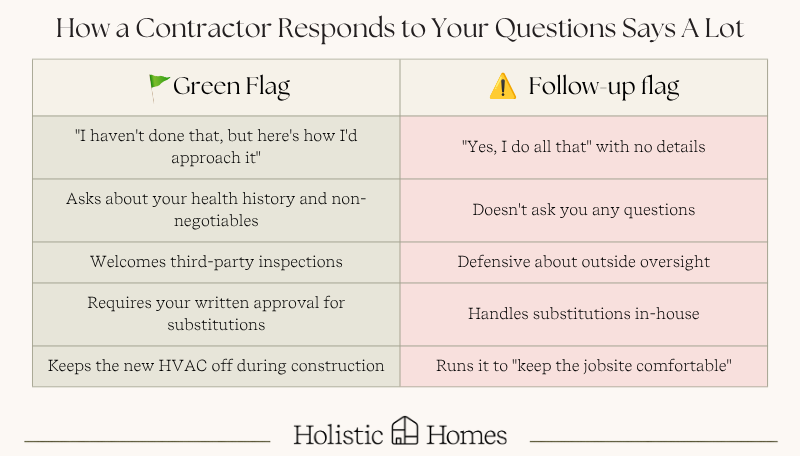
Pay attention to whether they ask you questions back. A good healthy home contractor wants to understand your health history, your sensitivities, and your non-negotiables. If they're not asking about you, they're not approaching this project as a partnership.
Pay attention to defensiveness versus curiosity. The contractor who gets prickly when you ask a detailed question is the contractor who will get prickly when something goes wrong on the project.
And pay attention to honesty about what they don't know. Coachability is rare and worth more than experience.
If you've worked through this interview with a few local contractors and walked away frustrated, you're not alone. The expertise to build a truly healthy home exists, but it's geographically scattered. The conventional building industry hasn't caught up to the questions your family is asking, and depending on where you live, you may be the most informed person in the room about the materials and protocols your home actually needs.
That's the gap the Holistic Homes Directory was built to fill. It's a national network of pre-vetted healthy building professionals (contractors, consultants, designers, and trades) who already speak this language. Many directory contractors consult remotely or travel for the right project, and a remote consultant paired with a coachable local contractor is often a strong combination.
Search the Holistic Homes Directory →
Plan to interview at least three to five. The first one is rarely the right one, and comparing answers to the same questions shows you quickly who is honest, who is curious, and who is telling you what you want to hear.
Ask how they monitor and control humidity on the job site, what they do if framing gets rained on, how long until the house is dried in, and how they waterproof and leak test showers. A builder who has clear answers, and dehumidifiers in their standard kit, takes moisture seriously.
On a healthy home project, usually not. Running a brand-new system during construction pulls drywall dust, particulate and off-gassing into the ductwork and equipment. Ask your builder how they'll keep the job site comfortable and the air clean without it.
Treat it as a follow-up, not an automatic deal-breaker, and ask why. Builders who've done healthy home work usually welcome outside eyes, because inspections protect their work too. Discomfort with oversight tells you how the project may go when there's a disagreement.
Paste this list at the end of the post, in this order. All three come from the blog writer's verified evidence library; re-open each link before publishing.
Related reading
Your family deserves a safe, healthy home. Let’s start planning together.
Tell Us About Your Project